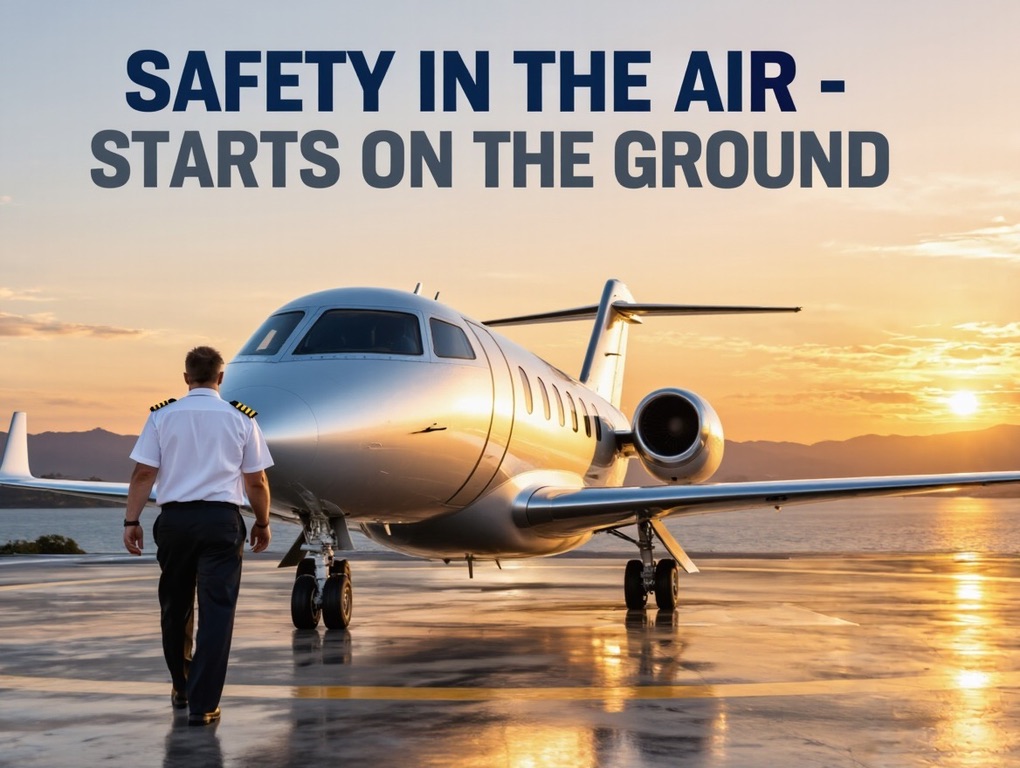
Safety is not something a pilot has. It is something a pilot does. Five principles that shift the focus from demanding human perfection to building resilient, fault-tolerant operations.
AACS Editorial Team | 2026 | 8-minute read
Redefining What Safety Is
For decades, industries traditionally viewed safety as a static destination to be reached or a game that could ultimately be won. However, the Human and Organisational Performance (HOP) framework revolutionised this perspective by completely redefining what safety actually is. According to safety expert Dr Todd Conklin, safety is not something an organisation or a pilot has; rather, it is something they actively do. Safety is the dynamic, continuous action of creating non-events in an unpredictable world.
Central to the HOP philosophy is the realisation that the worker, in this context the pilot, is not the root problem to be fixed, but rather the essential solution holding complex systems together. Pilots are actively involved in dynamically keeping aircraft and operations from failing. Because aviation is defined by the unexpected combination of normal system variability, pilots are constantly bombarded with dynamic, new situations.
The commercial airline industry has successfully embraced many of these operational concepts, resulting in a phenomenal safety record of roughly one fatal accident every decade despite millions of flights. In stark contrast, general aviation still experiences hundreds of fatal accidents annually. Bridging this safety gap requires a deep understanding of HOP. By embracing the five core principles of HOP, the aviation industry shifts its focus from demanding human perfection to building resilient, fault-tolerant operations.
Principle 1: People Make Mistakes (and Perfection Is Impossible)
The first and most foundational principle of HOP is the acceptance that people are inherently imperfect. Humans are incredibly intelligent, quick, and adaptive, but they are simply not reliable. Consequently, if we build aviation systems, whether mechanical, procedural, or organisational, that require perfect human performance to function safely, those systems will inevitably fail, often catastrophically.
In the aviation world, it is crucial to recognise that no matter how experienced a pilot is, small mistakes will be made on every single flight. The goal, therefore, is not the impossible task of eliminating mistakes, but rather building capacity or margin into the operation. Margin provides the necessary room for recoverability and resilience. When economic or operational production pressures shrink a pilot’s thinking time (the preparation, micro-simulation, and pre-planning phase), they are forced to rely heavily on acting time, essentially making up solutions on the fly without the safety net of preparation.
This loss of margin is where extreme danger lies. As expert performers gain experience, they often naturally operate closer to the margins of safety. The mere presence of risk is not the primary danger in aviation; rather, the absence of matching control and margin is what causes accidents. To fly safely is to acknowledge human fallibility and meticulously build in enough margin so that when an inevitable mistake occurs, the flight remains a non-event. This concept is illustrated by the story of Kenny, an alligator wrestler who survived a bite to the head. Kenny’s near-fatal mistake was not just a lapse in attention, but a situation of high risk exposure with very little control.
We cannot simply manage failures; we must manage our capacity to experience a failure without suffering a catastrophic consequence.
Principle 2: Blame Fixes Nothing
When an aviation incident occurs, human psychology naturally seeks out a culprit. It is emotionally satisfying to believe that an accident happened simply because a pilot was unskilled or made a foolish choice. However, the second principle of HOP asserts that blame fixes absolutely nothing and actively halts systemic improvement.
Mistakes are, by definition, unintended deviations from an expected outcome; they are never conscious choices. Yet the insidious nature of blame is that, in retrospect, it distorts mistakes to look exactly like intentional choices. When an organisation or an individual relies on blame, they stop looking for the underlying reasons behind the error. If an accident is written off simply as pilot error, the investigation practically ends, and the richer context of the failure is entirely missed.
In reality, a catastrophic aviation outcome requires multiple simultaneous failures across various organisational and mechanical layers. The seeds for the next major aviation event are already being planted systemically. This understanding is precisely why modern aviation safety relies heavily on anonymous, blame-free reporting systems. By removing the threat of punitive blame, pilots are empowered to share the exact details of their errors, allowing the industry to identify and fix the latent systemic conditions that actually cause accidents.
Principle 3: Learning Is Vital
Because aviation environments are highly dynamic, an organisation’s or a pilot’s ability to continuously learn is the ultimate definition of a mature, reliable system. The third principle of HOP highlights a vital psychological truth: the biggest enemy of learning is the belief that you already have the answer. Believing that you already know everything puts you in a dangerous position where you stop asking how events take place. Highly reliable aviation professionals approach their craft with deep humility, constantly questioning their motivations, decisions, and assumptions.
Crucially, learning must not be restricted solely to accidents. The exact same operational conditions exist during a highly successful flight as they do during a catastrophic one; the only difference is the final outcome. Therefore, pilots must diligently debrief and study their successful flights to understand what margins and safety controls were actively in place that allowed them to manage the system’s flexibility safely.
Curiosity serves as an essential safety tool in this continuous learning process. Instead of merely asking why an accident happened, which is often only emotionally satisfying, curious aviators ask how it happened, which is technically enlightening. By seeking out the how, pilots can proactively anticipate what additional resources, such as extra fuel, larger airports with better runways, or alternative routes, are needed to build recoverability into their future flights.
Principle 4: Context Drives Behaviour
If a pilot makes an error, the standard response is often to instruct them to be more careful next time. However, HOP recognises this as a fundamentally flawed and non-robust solution. The fourth principle dictates that human behaviour is not produced in a vacuum; it is deeply driven by its surrounding context. An individual will naturally behave completely differently in a biker bar than they will in a church, despite being the exact same person. The environment inherently dictates the behavioural expectations.
The commercial airline industry has effectively harnessed this principle by creating an intentional context of strict formality. The professional airline uniform, the epaulettes, and the highly structured procedural environment unconsciously drive adherence to safety protocols. The context expects and commands professional performance.
In contrast, a general aviation pilot who chooses to fly in flip-flops and a T-shirt may unknowingly strip away the psychological protective layers of formality. By consciously creating a formal environment, such as establishing strict personal rules about appropriate flying attire or using rigorous pre-flight routines, pilots can leverage their context to naturally elicit safer, more standardised behaviours without relying purely on willpower. Less experienced pilots must rely heavily on formal standard operating procedures to provide necessary structure and control, while highly experienced pilots use these procedures as a supportive framework to provide the finishing touches on a safe operation.
An example of leveraging context and learning to change behaviour was demonstrated by Admiral John Meyer in the US Navy. To reduce ground incursions on highly complex and constrained aircraft carrier decks, he painted a flight deck on an asphalt car park in Norfolk. He brought out old aircraft and allowed young personnel to practise moving aircraft in an easy-to-learn, low-risk environment. By changing the context and allowing the crew to trade roles and practise safely, he reduced flight deck incursions to near zero.
Principle 5: How Leaders Respond to Failure Matters
The final principle addresses the critical aftermath of an event. When a failure, mistake, or near miss occurs, the way leaders, or the pilots themselves, respond directly colours the future safety culture. An incident can be viewed negatively as a sunk cost, or honourably as an investment in learning and getting better.
Because pilots are dynamically keeping systems from failing, their response to a mistake must always default toward forward motion and improvement. Beating oneself up over an error is unproductive and changes nothing. Instead, the focus must immediately shift forward to analyse what indicators existed, what systemic conditions allowed the mistake to occur, and what concrete lessons can be carried into the future.
This mindset is especially vital when dealing with a near miss, which should be viewed as a gift: an accident without the mess.
Near miss good vs near miss lucky
Responding properly requires categorising the near miss correctly. A near miss good means that while an unexpected variation occurred, the pilot had built in sufficient margin and recoverability to regain control and land safely, reinforcing that the safety systems are actively working. Conversely, a near miss lucky indicates a situation where the pilot was out of control, and disaster was avoided solely by luck. Recognising a near miss lucky is a glaring warning that a significant risk component is unmanaged, demanding immediate systemic correction before it results in a tragedy.
Conclusion
The integration of Human and Organisational Performance principles marks a true paradigm shift in aviation safety. By acknowledging that human error is inevitable, discarding the destructive illusion of blame, fostering an insatiable curiosity for learning, deliberately designing behaviour-driving contexts, and responding to failures as crucial investments in safety, the industry can move far beyond baseline compliance.
True aviation safety is not achieved by attempting to programme perfect pilots, but by cultivating resilient systems, procedures, and margins that allow imperfect humans to navigate an inherently dangerous and dynamic sky safely.
Ready to build Human and Organisational Performance into your operation?
Contact AACS to explore how our Safety Management System, Human Factors, and advisory services can help your organisation build margin, learning, and resilience. Contact us.
References and further reading
- Conklin, T.: The 5 Principles of Human Performance (2019)
- Conklin, T.: Pre-Accident Investigations: An Introduction to Organizational Safety (2012)
- Dekker, S.: The Field Guide to Understanding ‘Human Error’ (3rd Edition, 2014)
- ICAO: Annex 19 Safety Management
- ICAO: Doc 9859 Safety Management Manual
- UK CAA: CAP 795 Safety Management Systems, Guidance to Organisations
Need Expert Advice?
AACS provides independent aviation advisory to governments, operators and insurers worldwide.
Get in Touch